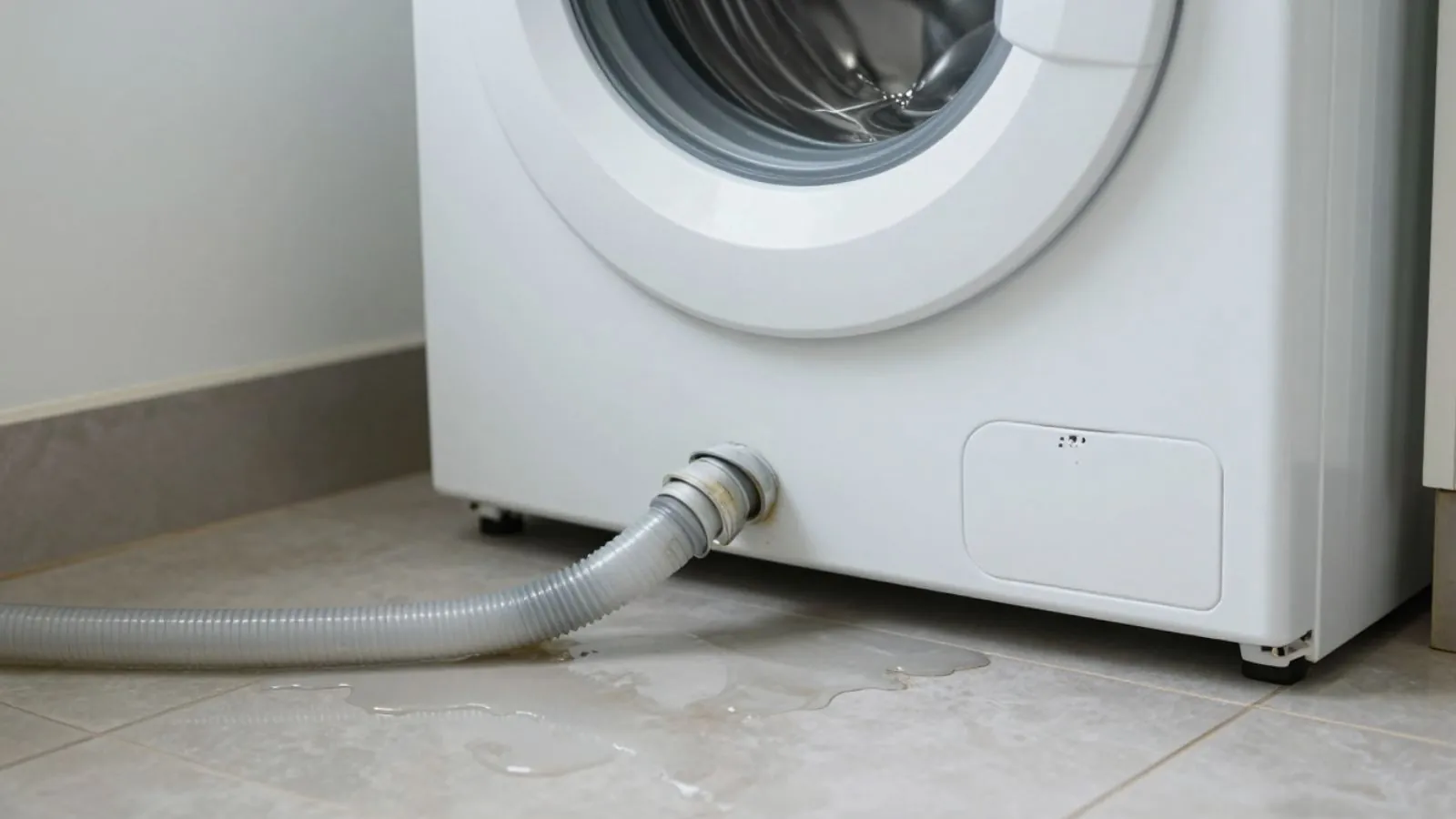
Most appliance leaks come from the supply hose or its connection, not from the machine itself. Close the shutoff valve behind or beside the appliance, unplug it only if the cord and outlet are dry and reachable, and mop up what you can. If water is spreading across the floor, call the 24/7 line.
The reason these leaks cause so much damage is that they run where nobody looks. A washing machine hose behind a stacked unit or a dishwasher line inside a cabinet can seep for weeks.
Where appliance water ends up
Washing machine
Water runs under the machine, into the subfloor and down through the ceiling of the room below if the laundry is upstairs.
Dishwasher
Water travels under the kitchen floor and into the toe-kick of the nearest cabinets.
Refrigerator or ice maker
A small line leak soaks flooring under and behind the fridge, often under the kitchen cabinets next to it.
Utility sink or laundry tub
Overflowing drains and slow seeps soak the wall base behind the tub.
Kitchens get the worst of it because cabinets sit over the leak path. See kitchen water damage restoration for the cabinet and flooring decisions that follow.
If the leak came from an upstairs laundry, check the ceiling below. A stain, sag or drip means water is already in the cavity and ceiling water damage repair applies.
| Sign | What it points to | Next step |
|---|---|---|
| Warped or cupped flooring near the machine | Slow seep under the appliance | Moisture readings, pull the appliance, dry the subfloor |
| Musty smell with no visible water | Wet cabinet floor or wall cavity | Open the toe-kick, check with a meter |
| Water stain on the ceiling below | Upstairs laundry or bath | Source repair plus ceiling and cavity drying |
| Pooling around the base | Failed hose or pan overflow | Close the valve, extract, replace the hose |
Water under the appliance?
Close the valve, then call. Dispatch can tell you what to photograph first.
How the cleanup and drying run
Crews photograph the wet areas, extract standing water and pull the appliance away from the wall. Moisture meters show where water traveled. Wet toe-kicks, baseboards and pad are removed, and the remaining materials are dried in place. The method is the same as for any extraction followed by structural drying, with extra care around cabinet bases and subfloor seams.
Cost factors
Scope and price are explained before work starts.
Insurers often treat a sudden hose burst differently from a leak that went unnoticed for a long time. Check your policy for wording on repeated seepage and keep the failed hose if you can, because it shows what happened.
Common questions
Hose and valve checks that prevent repeats
Rubber washing machine hoses can crack or bulge, and plastic dishwasher fittings can loosen over time. Braided stainless hoses are a common replacement, though a plumber or appliance technician should choose the right fitting for your machine. No hose has a guaranteed life, so check for bulges, rust at the couplings and damp spots when you do laundry.
Turning off the washer valves when you leave on a trip is a simple habit that closes off the pressure behind the hose. It costs a few seconds and removes the most common failure point.
If the leak came from the floor above
Upstairs laundry is a common source of ceiling stains in the room below. Water follows the joists and the plumbing penetrations before it shows on the ceiling, so the dry spot you can see may be only part of the wet area.
Crews check the ceiling, the wall cavity and the floor of the laundry room together, rather than treating them as separate problems. That is how the hidden wet spots get found before new materials go in.
Homes on the post-war streets around Deer Lake are one place these calls come from, and the Parkdale Estates and Deer Lake page covers the area.
Yes. A burst hose does not wait for business hours. Dispatch is staffed overnight, and a same-day response is offered when a crew is free, with no promised arrival time.
Not necessarily. The leak usually comes from a hose or fitting, which a plumber or appliance technician can replace.
Yes. Laminate and engineered wood absorb the water, and the subfloor can stay damp long after the surface looks dry.
No. Leave it off until the hose is checked or replaced.
Mold needs moisture and time. If the area stays damp or smells musty, read mold remediation and call for an assessment.